
FTL or LTL? Price Comparison and Decision Guide (2026)
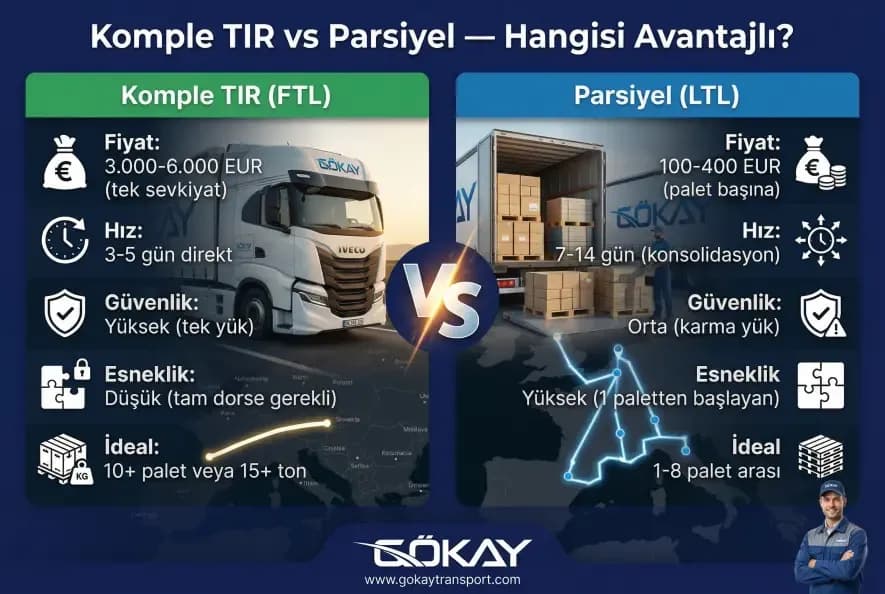
Every exporter planning an international shipment starts with the same question: FTL or LTL — which is more cost-effective? The answer depends on your cargo volume, the route, and your budget. In this guide we lay out the difference between FTL and LTL freight with concrete figures, share 2026 rate tables for 14 countries, and explain step by step when to choose which option. If you have already reviewed the fundamentals in our international freight guide, it is now time to determine the right transport mode.
FTL and LTL Freight Rates 2026
Full Truck Load (FTL) Rates by Country
All full truck load rates and LTL freight rates are ex-Istanbul, current 2026 ranges.
Route | FTL Rate | Estimated Transit |
|---|---|---|
Istanbul – Germany | 4,000 – 5,100 EUR | 5–7 days |
Istanbul – Italy | 4,000 – 4,500 EUR | 4–6 days |
Istanbul – Greece | 2,300 – 3,800 EUR | 1–2 days |
Istanbul – Bulgaria | 2,000 – 2,500 EUR | 1 day |
Istanbul – Romania | 2,400 – 3,200 EUR | 2–3 days |
Istanbul – North Macedonia | 2,700 – 3,200 EUR | 2 days |
Istanbul – Kosovo | 3,000 – 3,200 EUR | 2–3 days |
Istanbul – Albania | 3,200 – 3,500 EUR | 3 days |
Istanbul – Georgia | 2,500 – 3,100 USD | 1–2 days |
Istanbul – Russia | 7,500 – 11,000 USD | 7–12 days |
For detailed Greece rate examples and Bulgaria LTL rates, please visit the relevant country pages on our website.
LTL Freight Rates by Country
Route | EUR/LDM | EUR/Pallet (approx.) | Minimum Order |
|---|---|---|---|
Istanbul – Germany | 450 – 600 | 400 – 500 | 350 – 450 EUR |
Istanbul – Italy | 400 – 450 | 350 – 450 | 300 – 400 EUR |
Istanbul – Greece | 350 – 450 | 300 – 450 | 400 – 500 EUR |
Istanbul – Bulgaria | 350 – 420 | 300 – 480 | 350 – 450 EUR |
Istanbul – Romania | 380 – 460 | 350 – 450 | 300 – 400 EUR |
Istanbul – Georgia | 400 – 480 USD | 350 – 440 USD | 450 – 550 USD |
Important Note: Rates vary according to cargo type, volume, weight, season, and your specific requirements. For an up-to-date quote tailored to your shipment, contact us now.
What Is Full Truck Load (FTL)?
What is FTL? In logistics, FTL (Full Truck Load) means an entire vehicle is dedicated to a single customer's cargo. What is a full load? Simply put: the entire trailer is filled with your cargo and no other customer's goods are carried on the same vehicle.
What FTL and LTL mean — the fundamental difference is this: with FTL the truck is yours alone; with LTL the truck is shared. This simple distinction affects everything from price to transit time.
Standard Trailer Dimensions and Capacity
How many m³ does a full TIR hold? How many pallets does a full TIR carry? What LDM capacity does a full TIR have? Here are the precise answers:
Trailer Type | Internal Dimensions (L×W×H) | Volume (m³) | Pallets (euro) | Max Payload |
|---|---|---|---|---|
Curtainsider (standard) | 13.6 m × 2.45 m × 2.70 m | ~90 m³ | 33 | 24 tonnes |
Mega trailer | 13.6 m × 2.45 m × 3.00 m | ~100 m³ | 33 (higher stacking) | 24 tonnes |
Refrigerated trailer | 13.6 m × 2.45 m × 2.50 m | ~82 m³ | 33 | 24 tonnes |
Full TIR dimensions are fixed: a standard trailer length is 13.6 metres, i.e. 13.6 LDM of capacity. Our full truck load service covers curtainsider, mega, and refrigerated trailer options.
What Is LTL (Less Than Truck Load) Freight?
What is LTL freight? What does LTL mean in logistics? What is LTL? (Less Than Truck Load) In brief: the cargo of multiple customers is consolidated onto the same vehicle. What is an LTL shipment? It refers to consignments that do not fill an entire truck — typically in the 1–15 pallet range.
What is LTL freight? operationally: shipments are collected at a consolidation depot, combined with other cargo heading to the same destination, and dispatched on a shared TIR. This process reduces costs but adds dwell time. Thanks to Gökay Transport's weekly scheduled departure programme, consolidation waiting time is kept to a minimum, as explained in our LTL freight details section, consolidation waiting time is kept to a minimum.
What Is LDM and How Is It Calculated?
What is LDM? In logistics, LDM (Loading Metre / Laademeter) represents a 1-metre-deep loading area across the full trailer floor width. It is the most widely used unit in LTL pricing.
Calculation formula: Number of pallets × pallet width (cm) ÷ 240 = LDM
Example: 5 euro pallets (80 cm wide) = 5 × 80 ÷ 240 = 1.67 LDM

What Are the Differences Between FTL and LTL Freight?
Criterion | Full Truck Load (FTL) | LTL Freight |
|---|---|---|
Vehicle allocation | Dedicated truck — your cargo only | Shared truck — multiple customers |
Cost | Fixed price (per route) | Unit price × volume (LDM, m³, pallets) |
Transit time | Short, direct delivery | 2–5 extra days (consolidation + distribution) |
Damage risk | Low (single load/unload) | Higher (multiple handling operations) |
GPS tracking | Full real-time tracking | Limited (while awaiting at depot) |
CMR document | Single CMR, single liability | Shared CMR, shared liability |
Minimum cargo | Volume to fill the entire vehicle | From 1 pallet upwards |
Flexibility | Flexible loading/unloading times | Schedule-dependent |
Ideal use | 20+ pallets, urgent, fragile cargo | 1–15 pallets, regular small shipments |
Customs and documentation processes are identical for both transport modes; however, with a full truck load a single customs declaration is filed, whereas with LTL each customer's cargo may require a separate declaration.
FTL Advantages and Disadvantages
Advantages:
- Fast transit: There are no intermediate stops or consolidation delays. Your cargo goes directly to the destination.
- Low damage risk: There is a single loading and a single unloading operation; handling is kept to an absolute minimum.
- Full real-time GPS tracking: With GPS equipment fitted to all Gökay Transport vehicles, you can monitor your cargo in real time at any moment.
- Single CMR document: Insurance liability is unified; as explained in our insurance coverage by transport mode guide, the claims process is straightforward.
- Flexible scheduling: You set the loading and unloading times yourself.
Disadvantages:
- Higher unit cost: If the truck is not fully loaded, you still pay for the empty space. If you have 10 pallets, 70% of the vehicle remains empty.
- Advance planning required: Vehicle reservations must be made in advance; last-minute availability may be limited.
LTL Freight Advantages and Disadvantages
Advantages:
- Lower unit cost: You pay only for the space you use. For small shipments you can save 50–70% compared to a full truck load.
- Flexible volume: From 1 pallet upwards — ideal for SMEs and regular small orders.
- Regular scheduled departures: Thanks to Gökay Transport's weekly guaranteed departure schedule, your cargo departs within 7 days at the latest.
- Accessibility: Companies that cannot afford a full truck load can still benefit from international freight services.
Disadvantages:
- Consolidation dwell time: There may be a wait of 1–3 days while cargo is being consolidated.
- Multiple handling risk: The number of handling operations increases, raising the risk of damage.
- Limited tracking: GPS tracking may be interrupted while cargo is at a consolidation depot. Gökay Transport's own fleet minimises this risk.
- Shared CMR: Because multiple customers share the same vehicle, insurance liability is also shared.
To find out which transport mode suits your needs, consult our team of experts. Get free advice on WhatsApp or call us directly on +90 533 302 33 10.
From How Many Pallets Does FTL Become More Cost-Effective?
LTL or FTL — the answer depends on cargo volume and the route. Let us define the break-even point clearly:
- 1–8 pallets: LTL is definitively more economical.
- 8–20 pallets: Varies by route. A detailed price comparison is essential.
- 20+ pallets or cargo occupying 60–70% of the vehicle: FTL becomes the economical choice.
Urgent and fragile cargo: Regardless of volume, FTL should be preferred for shipments with a critical delivery date or low damage tolerance (glassware, electronics, hanging garments).
Sector-Based Transport Mode Recommendations
- Textiles: Use FTL during peak seasons (S/S and F/W collection periods); use LTL for replenishment orders and samples. FTL is mandatory for hanging-garment transport. See our best choice for textile cargo guide for full details.
- Food / Refrigerated: Since temperature control is critical, in the refrigerated FTL vs LTL decision a full refrigerated truck is generally the priority. Cold-chain LTL is also possible for small lots.
- Machinery / Heavy cargo: Shipments requiring special equipment (lowbed, flatbed) are generally FTL. LTL is suitable for spare-part consignments.
- SMEs / E-commerce: LTL is ideal for regular small orders. The best transport solution for SMEs is LTL in most cases.
- Automotive parts: FTL for JIT (Just-in-Time) deliveries; LTL for spare-parts stock replenishment.

How Is Freight Calculated for LTL and FTL Shipments?
Road freight calculation methods differ by transport mode.
FTL freight: Fixed price determined by route, trailer type, and season. FTL rates are shown by route in the table above.
LTL freight calculation is based on a unit price × volume formula:
LTL Freight Calculation Formula
LTL volume calculation and LTL rate calculation steps:
- Calculate volume: Length × Width × Height (cm) ÷ 1,000,000 = m³
- Calculate LDM: Number of pallets × pallet width (cm) ÷ 240 = LDM
- Calculate freight: Unit price (EUR/LDM or EUR/m³) × volume = total freight
- Minimum check: If the calculated amount is below the minimum order value, the minimum applies
- Weight check: In LTL rate calculation, volume and weight are compared; whichever is higher (chargeable weight) is used as the basis
For detailed information about your export documents and how to include document costs in your freight calculation, please refer to our relevant guide.
Send us your cargo details for an LTL freight calculation and we will provide a quote the same day. Contact us on WhatsApp.
Practical Scenarios: LTL or FTL?
Let the numbers speak. The following 3 realistic scenarios will help you make your decision.
Scenario 1: 5 Pallets of Textiles — Istanbul to Germany
Germany LTL freight example:
Criterion | LTL | FTL |
|---|---|---|
Cargo volume | 5 euro pallets = 2 LDM | 5 pallets (15% of vehicle) |
Freight | 2 LDM × 320 EUR = ~640 EUR | 3,500 – 4,500 EUR |
Transit time | 7–10 days | 5–7 days |
Outcome | LTL wins | Excessive cost |
In this scenario, booking a full truck load would be 5–6 times more expensive. You can find more detail on our Germany freight rate comparison page.
Scenario 2: 25 Pallets of Food — Istanbul to Italy
Criterion | LTL | FTL |
|---|---|---|
Cargo volume | 25 pallets = 10 LDM | 25 pallets (76% of vehicle) |
Freight | 10 LDM × 290 EUR = ~2,900 EUR + local charges ~500 EUR = ~3,400 EUR | 3,200 – 4,500 EUR |
Transit time | 7–9 days | 4–6 days |
Outcome | Costly | FTL wins |
At 25 pallets, LTL including local charges approaches or even exceeds the FTL cost — and transit is 3–4 days longer. When 76% of the vehicle is filled, FTL is far more sensible. You can further optimise transit time with Italy Ro-Ro options.
Scenario 3: 12 Pallets of Machinery — Izmir to Romania
LTL freight from Izmir — a break-even point example:
Criterion | LTL | FTL |
|---|---|---|
Cargo volume | 12 pallets = 4.8 LDM | 12 pallets (36% of vehicle) |
Freight | 4.8 LDM × 240 EUR = ~1,152 EUR + local ~300 EUR = ~1,450 EUR | 1,200 – 1,800 EUR |
Transit time | 5–7 days | 2–3 days |
Outcome | Prices are close | Depends on the route |
A shipment close to the break-even point. The LTL price advantage is small, but the transit time difference is 3–4 days. If urgent delivery is required, choose FTL; if budget is the priority, LTL may be preferred. Current rates are available on our Romania route rates page.
Would you like a similar calculation done for your cargo? Get a free quote.

Transit Time Comparison: FTL vs LTL — How Big Is the Gap?
Route | FTL | LTL | Difference |
|---|---|---|---|
Istanbul – Germany | 5–7 days | 7–12 days | +2–5 days |
Istanbul – Italy | 4–6 days | 6–10 days | +2–4 days |
Istanbul – Greece | 1–2 days | 3–5 days | +2–3 days |
Istanbul – Bulgaria | 1 day | 2–4 days | +1–3 days |
Istanbul – Romania | 2–3 days | 4–7 days | +2–4 days |
Istanbul – Georgia | 1–2 days | 3–5 days | +2–3 days |
Reasons for the extra time in LTL: consolidation dwell (1–3 days), multiple delivery points (1–2 days), and sometimes transhipment depot processes. Gökay Transport's weekly Wednesday and Friday guaranteed departures for European routes and Tuesday and Thursday regular services on the Balkans corridor keep waiting time to a minimum.
Why Work with Gökay Transport?
LTL freight providers and LTL transport companies — here is what sets Gökay Transport apart:
- L2 Licence (U.NET Registered): The highest-level authorisation certificate required for international road haulage. Checking for an L2 licence when choosing a carrier is non-negotiable.
- CMR Insurance: Every shipment, whether FTL or LTL, is covered by 100% CMR insurance. Your claims process in the event of damage is fully protected.
- Live GPS Tracking: With GPS equipment fitted to our own fleet, you can track your cargo 24/7 in real time. Tracking continuity is maintained even for LTL shipments.
- 16 Years of Experience: Since 2010 we have successfully completed tens of thousands of FTL and LTL shipments.
- 14-Country Service Network: From the Balkans to the Caucasus, and from Western Europe to Russia, our extensive route network means we have a solution for both your FTL and LTL shipments.
- Weekly Scheduled Departures: Our guaranteed departure calendar, which keeps LTL consolidation waiting time to a minimum, ensures your shipments are predictable.
Whether FTL or LTL, call us for a guarantee of professional and reliable freight to 14 countries: +90 533 302 33 10.

Frequently Asked Questions (FAQ)
How many cubic metres of cargo does a full TIR truck hold?
A standard curtainsider trailer has approximately 90 m³, a mega trailer 100 m³, and a refrigerated trailer 82 m³ of usable volume. The maximum payload for all trailer types is 24 tonnes. Both the volume and the weight of your cargo must remain within these limits.
How many pallets does a standard TIR truck carry?
A standard curtainsider trailer accommodates 33 euro pallets (80 × 120 cm) or 26 industrial pallets (100 × 120 cm). For products that can be double-stacked, this figure can rise to 66 euro pallets. Mega trailers offer additional stacking capacity thanks to their greater internal height.
What is the LDM capacity of a TIR truck?
The capacity of a standard curtainsider trailer is 13.6 LDM. One LDM represents a floor area 2.40 metres wide and 1 metre deep inside the trailer. 1 euro pallet = 0.4 LDM. LDM is the most widely used unit when pricing LTL shipments.
How is LTL freight price calculated?
LTL freight calculation is generally based on a per-LDM or per-m³ unit price. Formula: unit price × volume = total freight. The weight/volume ratio is checked; whichever is higher is used as the basis. Each route has a minimum order amount. You can request a free calculation from Gökay Transport.
What are the main differences between FTL and LTL?
FTL (Full Truck Load) means an entire vehicle is dedicated to a single customer's cargo and direct delivery is made; transit time is short. LTL (Less Than Truck Load) means multiple customers' cargo is carried on the same vehicle; costs are shared but consolidation dwell time is added. FTL offers lower damage risk; LTL offers a cost advantage.
From how many pallets does FTL become more cost-effective?
General rule: 20+ pallets or 60–70% of the vehicle filled makes FTL the economical choice. Fewer than 8–10 pallets and LTL is definitively advantageous. Between 10 and 20 pallets a detailed route-by-route comparison is needed. To determine the best option for your specific cargo, message us on WhatsApp.
Is there a risk of handling damage with LTL freight?
Yes, in LTL transport the risk of damage during loading, unloading, and transhipment at the consolidation depot is higher than with FTL. This is why CMR insurance is critically important. Gökay Transport carries out all FTL and LTL shipments under CMR insurance coverage.
Are local charges different for FTL and LTL?
Yes, there is a noticeable difference. With FTL there is a single loading and a single unloading operation, so local charges are minimal. With LTL, additional line items such as depot handling fees, palletising, consolidation service, and distribution charges are added to the freight price. You need to factor in local charges when comparing LTL prices.
How should you choose among LTL freight providers?
When selecting a provider, check for an L2 licence, CMR insurance coverage, live GPS tracking capability, a weekly regular departure programme, sector references, and price transparency. Companies with a U.NET registration are subject to official oversight and are more reliable.
How much longer is transit time for an LTL shipment?
For LTL shipments, transit time is on average 2–5 days longer than FTL. The reason: consolidation dwell time (1–3 days) and time spent at multiple distribution points (1–2 days). Gökay Transport's weekly scheduled departure programme keeps waiting time to a minimum.
Is FTL or LTL more suitable for textile cargo?
In the textiles sector, the decision depends on seasonal volume. During S/S and F/W collection periods, FTL should be chosen for high-volume shipments. LTL is more economical for replenishment orders and sample consignments. For hanging-garment transport, FTL takes priority.
What is LDM and how is it calculated?
LDM (Loading Metre / Laademeter) represents a 1-metre-deep loading area across the full width of the trailer floor. Calculation: number of pallets × pallet width (cm) ÷ 240. For example, 5 euro pallets (80 cm wide) = 5 × 80 ÷ 240 = 1.67 LDM. A standard curtainsider trailer has a total of 13.6 LDM available.
If you have any further questions, you can reach us at any time. Get an instant response on our WhatsApp line or call +90 533 302 33 10.
Frequently Asked Questions
A standard curtainsider trailer has approximately 90 m³, a mega trailer 100 m³, and a refrigerated trailer 82 m³ of usable volume. The maximum payload for all trailer types is 24 tonnes. Both the volume and the weight of your cargo must remain within these limits.
A standard curtainsider trailer accommodates 33 euro pallets (80 × 120 cm) or 26 industrial pallets (100 × 120 cm). For products that can be double-stacked, this figure can rise to 66 euro pallets. Mega trailers offer additional stacking capacity thanks to their greater internal height.
The capacity of a standard curtainsider trailer is 13.6 LDM. One LDM represents a floor area 2.40 metres wide and 1 metre deep inside the trailer. 1 euro pallet occupies 0.4 LDM. LDM is the most widely used unit when pricing LTL shipments.
LDM (Loading Metre / Laademeter) represents a 1-metre-deep loading area across the full width of the trailer floor. Calculation: number of pallets × pallet width (cm) ÷ 240. For example, 5 euro pallets (80 cm wide) = 5 × 80 ÷ 240 = 1.67 LDM. A standard curtainsider trailer has a total of 13.6 LDM available.
Related Articles
Bulgaria Freight 2026 | Daily Scheduled Departures & Freight Rates
Full-load, part-load, and refrigerated transport solutions from Istanbul to Sofia starting from €200. Browse our current rate sheet for safe, fast delivery.
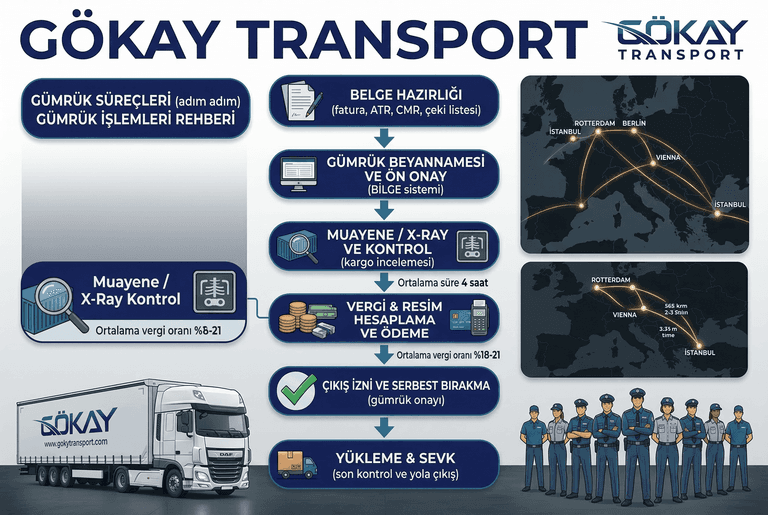
Customs Procedures Guide: Everything You Need to Know About Road Freight (2026)
How are customs procedures handled in road freight? 2026 customs broker fees, border crossings, and required documents — call us for a free consultation.
Food Export & Refrigerated Transport Guide: Prices, Documents and Cold Chain Logistics 2026
Refrigerated transport prices 2026: country-by-country cold chain shipping rates, ATP certificate, food export documents. Call now for a free quote.
Get in Touch
Available 24/7
You can reach us by email, by phone, or by filling out the form on this page. We aim to respond to your messages as quickly as possible and look forward to connecting with you!
Frequently Asked Questions (FAQ)Write to Us
We would love to hear from you!