
Documents Required for Export: 2026 Road Freight Export Guide
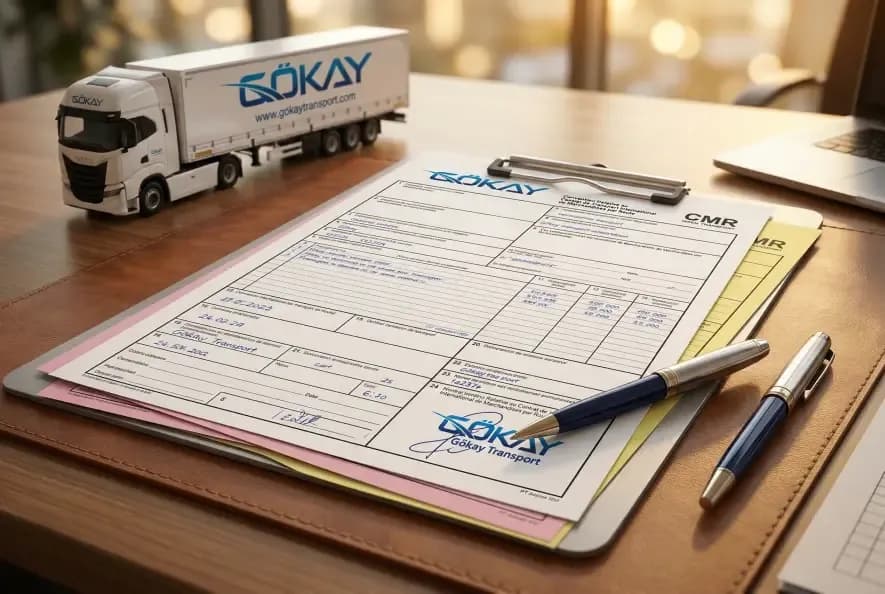
Documents required for export, are a critical issue for every company starting to export or wishing to review their existing processes. Preparing the correct documents on time is the only way to avoid delays at customs and keep costs under control. How to export — the answer always starts with paperwork: commercial invoice, customs declaration, certificate of origin, CMR consignment note, and sector-specific certificates.
This export guide has been prepared specifically for road freight export in line with 2026 regulations. As Gökay Transport, with regular shipments to 14 countries since 2010, we have compiled the document processes we encounter in the field every day. While the general process is covered on our international freight processes guide page, this article focuses specifically on documents.
Documents Required for Export 2026: Complete List
The table below provides a complete overview of documents used in export at a glance. This table is the shortest answer to the question what are export documents:
Document Name | Issuing Authority | Validity | 2026 Fee (ITO) |
|---|---|---|---|
Commercial Invoice | Exporter company | Per shipment | - |
Proforma Invoice | Exporter company | Per quotation | - |
Packing List | Exporter company | Per shipment | - |
Customs Declaration | Customs broker (BİLGE) | Per shipment | Broker fee |
A.TR Movement Document | Chamber of commerce | 4 months | 60 TL |
EUR.1 Movement Document | Chamber of commerce | 4 months | 60 TL |
Certificate of Origin | Chamber of commerce / Exporters' association | 12 months | 60 TL |
CMR Document (Road Consignment Note) | Freight carrier | Per shipment | - |
TIR Carnet | TOBB / IRU | Per transit | Variable |
Health Certificate (food) | Provincial Directorate of Agriculture | Per shipment | Variable |
CE Certificate (industrial) | Accredited body | Varies by product | Variable |
Important Note: The fees in this table are Istanbul Chamber of Commerce (ITO) document prices for 2026. Customs broker fees and sector-specific certification costs must be calculated separately.

Export Document Costs and Fees 2026
Export document costs are one of the most frequently asked topics among companies that are new to exporting. We have compiled this information — unavailable on any competitor site — for you.
ITO Document Prices 2026
Document Type | Fee |
|---|---|
A.TR Movement Document | 60 TL |
Simplified A.TR | 30 TL |
Certificate of Origin | 60 TL |
Form-A Certificate of Origin | 60 TL |
EUR.1 Movement Document | 60 TL |
EUR-MED Movement Document | 60 TL |
D-8 Proof of Origin Document | 60 TL |
TPS-OIC Proof of Origin Document | 60 TL |
Proof of Origin Document (Iran) | 60 TL |
TR-AZ Form Proof of Origin | 60 TL |
Customs Broker Fees 2026
Export document fees include not only the price of the document itself but also the customs brokerage service charge.
Transaction Type | Minimum Fee Range |
|---|---|
Customs brokerage (standard) | 50 - 15,940 TL |
Authorised customs brokerage | 350 - 332,960 TL |
Companies holding DTSŞ/AEO status receive a | 20% discount applied |
Important Note: Prices are based on the minimum fee tariff effective 1 January 2026. For companies exporting for the first time, the total setup cost (including chamber registration, consultancy, and software integration) can reach up to 220,000 TL. Let us handle your documents — get a free freight quote.
Export Process Stages and Document Flow
Export process stages follow a defined sequence from order confirmation through to delivery of goods to the buyer. Here is the step-by-step answer to how to export by road:
- Order confirmation and proforma invoice — Price, quantity, delivery terms (Incoterms), and payment conditions are agreed with the buyer. A proforma invoice is issued.
- Production / procurement and packaging — Products are palletised in accordance with export requirements. The packing list is prepared.
- Issuing the commercial invoice — The export invoice is issued through the e-Invoice portal. A foreign currency denomination (EUR/USD) is preferred.
- Power of attorney to customs broker — The broker is authorised via a notarised power of attorney. Export customs procedures are then handled by the broker.
- Application for movement / origin document — Depending on the destination country, an application is made to the chamber of commerce for an A.TR, EUR.1, or certificate of origin.
- Opening the customs declaration — The export customs declaration is opened electronically via the BİLGE system. The HS code, customs value, and weight details are entered.
- Loading and issuing the CMR — The freight carrier carries out loading and the CMR document is issued. The choice between full truck load (FTL) and groupage (LTL) is made at this stage.
- Dispatch and tracking — The vehicle departs. You can monitor your shipment in real time via the GPS live tracking system.
Leave the logistics side of the export process to us. Contact us directly on WhatsApp.

Commercial Documents: Invoice, Proforma, and Packing List
Commercial documents are the most fundamental among all export paperwork. Required for every shipment, they are the first checkpoint at customs.
Commercial Invoice
How to issue an export invoice is the first question faced by those starting to export. A commercial invoice must include the following information:
- Seller and buyer company details (name, address, tax number)
- Product description, HS code, unit price, and total value
- Currency (EUR, USD, or TL)
- Delivery terms (Incoterms: FOB, CIF, DAP, etc.)
- Payment terms and due date
Can an export invoice be issued in Turkish lira? Yes, it is legally permissible. However, in international trade, EUR or USD is preferred both by the buyer and the customs authority.
Proforma Invoice
A proforma invoice is a non-binding preliminary quotation document. It is used in the buyer's country for import licensing, opening a letter of credit, or preliminary customs valuation. After order confirmation it is converted into a commercial invoice.
Packing List
The packing list shows the details of each carton/pallet in the shipment: number of packages, gross/net weight, volume (m³), pallet dimensions. At customs it is compared against the declaration during physical inspection. An incomplete or incorrect packing list prolongs the inspection process.
Customs Documents: Declaration, HS Code, and the BİLGE System
detailed customs procedures guide page covers the full process; here we focus on document details specific to exporters.
What Is a Customs Declaration and How Is It Opened?
A customs declaration is the official notification to the customs authority of goods to be exported. This 54-field form is opened electronically via the BİLGE (Computerised Customs Activities) system.
An exporter cannot open a declaration directly. A notarised power of attorney to a customs broker is mandatory. Once the declaration is opened, the system automatically assigns a processing lane:
- Green lane: No document check or inspection — direct clearance
- Yellow lane: Document check only
- Red lane: Document check + physical inspection
- Blue lane: Post-clearance control (goods released, documents reviewed later)
Why Is the HS Code Important?
The HS code (Harmonised System / Customs Tariff Statistical Position) is the customs classification of the goods to be exported. An incorrect HS code carries serious consequences: an administrative fine of between 10% and 200%, additional customs duties, and even rejection of the goods. Verify the correct code from the Ministry of Trade Tariff Schedule or your customs broker.
Origin and Movement Documents: A.TR, EUR.1, Certificate of Origin
Movement and origin documents prove in which country the exported goods were produced or that they are in free circulation. Different document types are required depending on the destination country.
What Is an A.TR Document and for Which Countries Is It Issued?
The A.TR document is a movement document issued for industrial goods under the Customs Union between Turkey and the EU. It grants exemption from customs duties. You can find the Greece A.TR document requirements in detail on the relevant page on our site.
For which countries is the A.TR document issued? All EU member states: Germany, France, Italy, Spain, the Netherlands, Belgium, Greece, Bulgaria, Romania, and others. Agricultural products are excluded from A.TR coverage.
What Is a EUR.1 Document and for Which Countries Is It Issued?
The EUR.1 document is a preferential origin document issued for countries with which Turkey has a Free Trade Agreement (FTA). For which countries is the EUR.1 document issued? North Macedonia, Albania, Kosovo, Georgia, Serbia, Bosnia-Herzegovina, Morocco, Tunisia, Egypt, and other FTA countries.
With EUR.1, a customs duty reduction (generally 0% or a reduced rate) is obtained in the destination country. Unlike A.TR, proof of origin is mandatory — it must be documented that the goods are of Turkish origin.
What Is a Certificate of Origin?
A certificate of origin is a general-purpose origin document indicating in which country the product was manufactured. It is used for shipments to countries not covered by an FTA or the Customs Union. Where is a certificate of origin obtained? Applications are made through the relevant chamber of commerce or exporters' association via the MEDOS system. The validity period is 12 months.
A.TR vs EUR.1 vs Certificate of Origin: Comparison Table
The difference between a EUR.1 document and an A.TR is one of the most frequently confused topics. The table below compares all three documents:
Criterion | A.TR | EUR.1 | Certificate of Origin |
|---|---|---|---|
Scope | EU Customs Union | FTA countries | All countries |
Product category | Industrial goods only | All products | All products |
Origin requirement | None (free circulation) | Required (Turkish origin) | Required |
Benefit provided | Customs exemption | Customs duty reduction | Proof of origin |
Validity | 4 months | 4 months | 12 months |
2026 fee (ITO) | 60 TL | 60 TL | 60 TL |
Issuing authority | Chamber of commerce | Chamber of commerce | Chamber of commerce / Exporters' assoc. |

Road Transport Documents: CMR, TIR Carnet, and Consignment Note
Export transport documents are a topic that none of the competing guides cover in detail. Yet in road freight export, the CMR document and TIR carnet are just as critical as the commercial documents. Road transport documents — here we share Gökay Transport's first-hand field knowledge with you.
CMR Document (Road Consignment Note)
The CMR document is an international road consignment note governed by the 1956 CMR Convention. It records the acceptance of the goods, the transport conditions, and delivery details. Information that must appear on the CMR document includes:
- Consignor name and address (box 1)
- Consignee name and address (box 2)
- Place of delivery (box 3)
- Place and date of loading (box 4)
- Nature of goods, number of packages, type of packaging (boxes 6–9)
- Gross weight and volume (boxes 11–12)
- Carrier's instructions (box 13)
- Freight information and payment conditions (boxes 14–15)
The CMR document is issued in 3 copies: one for the consignor, one for the carrier, and one for the consignee. Under what circumstances is a CMR document invalid? It is considered invalid if the consignor's or carrier's signature is missing, the loading date is absent, or the goods description does not match the customs declaration.
In the event of damage or loss, the carrier's liability under the CMR Convention is limited to 8.33 SDR/kg. For this reason, always research the question what is CMR insurance. Gökay Transport carries out all shipments under CMR insurance coverage.
TIR Carnet
The TIR carnet is an international document issued under the 1975 TIR Convention that provides customs exemption for transit passages. It eliminates the requirement to deposit customs guarantees in transit countries and shortens border-crossing times.
It is issued by IRU (International Road Transport Union) through TOBB (Union of Chambers and Commodity Exchanges of Turkey). Documentation for groupage shipments may differ; for groupage loads, a T1 transit document may be used instead of the TIR carnet.
L2 Licence and the Carrier's Legal Requirements
Holding an L2 licence is a legal requirement for any company engaged in road haulage. Registration in U.NET (the Electronic Transport Tracking and Supervision System) confirms that the company is officially authorised to carry out international transport.
Always verify the L2 licence when choosing a freight carrier. Working with unlicensed companies carries both legal risk and the risk of falling outside insurance coverage. Gökay Transport has been conducting international transport since 2010 with a U.NET-registered L2 licence.
For detailed information on the CMR document and the transport process, contact us: +90 533 302 33 10 or message us on WhatsApp.
Sector-Specific Export Documents
In addition to the core documents, certificates required for export vary by sector. Here are the additional document requirements for the most commonly exported sectors:
Documents Required for Food Export
special document requirements for food export are covered in full detail on a dedicated page. In summary:
- Health certificate (Provincial Directorate of Agriculture and Forestry)
- Phytosanitary certificate (for plant-based products)
- Veterinary health certificate (for animal products)
- Halal certificate (Middle East and North Africa countries)
- RASFF compliance (food exports to EU countries)
Documents Required for Textile Export
the documentation process for textile export guide has the full details. Core requirements:
- CE marking (for certain textile products for the EU market)
- Oeko-Tex certificate (harmful substance testing)
- REACH compliance (chemical substance regulation, EU)
- Labelling requirements (care instructions, fabric content)
Documents Required for Micro-Export
Micro-export documents differ from standard export paperwork and are simpler:
- ETGB (Electronic Commerce Customs Declaration) — via a courier/cargo company
- Proforma invoice
- Copy of ID / tax registration certificate
- Exporter's declaration
- 15,000 EUR shipment limit (standard export procedures apply above this threshold)
Chamber of commerce registration or exporters' association membership is not required. This means sole traders and small businesses can export with ease.
Export Documents by Country: EU, Balkans, CIS
The table below shows which documents are required for each of the 14 countries Gökay Transport serves. Documents required for export to Europe differ from those applicable to CIS country shipments.
Country | A.TR | EUR.1 | Cert. of Origin | Special Document | Note |
|---|---|---|---|---|---|
Germany | Yes | - | - | CE required | EU Customs Union |
Italy | Yes | - | - | CE required | EU Customs Union |
Greece | Yes | - | - | CE required | EU Customs Union |
Bulgaria | Yes | - | - | CE required | EU Customs Union, Kapıkule route |
Romania | Yes | - | - | CE required | EU Customs Union |
North Macedonia | - | Yes | - | - | Under FTA |
Kosovo | - | Yes | - | - | Under FTA |
Albania | - | Yes | - | - | Under FTA |
Georgia | - | Yes | - | - | Under FTA |
Armenia | - | - | Yes | - | Certificate of origin sufficient |
Russia | - | - | Yes | EAC/GOST-R | Special certificate required |
EU Countries: Germany, Italy, Greece, Bulgaria, Romania
Documents required for export to Germany: A.TR document (industrial goods), commercial invoice, packing list, CMR document, and CE marking. We have detailed the export documents for Germany topic on the relevant page. You can also browse the dedicated pages for Italy export procedures and Bulgaria freight documents.
For exports to EU countries, the A.TR document is sufficient for industrial goods. For agricultural products, EUR.1 or a preferential origin declaration is required. CE marking is mandatory for many product categories.
Balkan Countries: North Macedonia, Kosovo, Albania
Balkan countries are covered by a Free Trade Agreement with Turkey. EUR.1 provides a customs duty reduction. Special certificate requirements are generally absent, though a health certificate may be required for food products.
CIS Countries: Georgia, Armenia, Russia
Georgia has an FTA with Turkey, so the EUR.1 document is used. For Armenia, a certificate of origin is sufficient. Russia's special document requirements are more complex: an EAC (Eurasian Conformity) or GOST-R certificate is mandatory for many product categories.
Tell us which country you are shipping to — we will manage the entire process from documentation to delivery. Get a free quote.

Common Mistakes in Export Documentation
export paperwork errors lead to customs delays, additional costs, and even rejection of goods. Here are the 7 most common mistakes:
1. Incorrect HS code: An error in product classification can result in an administrative fine of between 10% and 200%. Provide your customs broker with full product details.
2. Invoice–declaration mismatch: A discrepancy in quantity, weight, or value between the invoice and the declaration is grounds for referral to physical inspection. Cross-check both documents against each other.
3. Missing origin/movement document: Goods shipped without an A.TR or EUR.1 will be subject to full customs duties in the destination country. You will not benefit from any reduction.
4. Incomplete information on the CMR: A missing signature, wrong date, or error in the goods description renders the CMR invalid. In the event of damage, you will not be able to make a compensation claim.
5. Expired certificate: The validity of a CE certificate, health certificate, or origin document is often overlooked. An expired document will not be accepted at customs.
6. Incorrect Incoterms: When the delivery terms do not match the actual transport arrangement, liability becomes unclear. The same Incoterms code must appear on the invoice, declaration, and CMR.
7. e-Invoice format error: Failure to issue the export invoice as an export-type document through the Revenue Administration (GİB) e-Invoice portal delays the VAT refund process.
Export Document Checklist
how to prepare export documents — the most practical answer is the checklist below. Tick off each item before shipment:
Before Loading: - [ ] Has the proforma invoice been approved? - [ ] Has the commercial invoice been issued? (e-Invoice, export type) - [ ] Is the packing list ready? (packages / pallets / weight / volume) - [ ] Has the HS code been confirmed? - [ ] Has the power of attorney to the customs broker been granted? - [ ] Has the movement document (A.TR/EUR.1) or certificate of origin been applied for? - [ ] Are sector-specific certificates up to date? (CE, health, halal, etc.)
Customs Stage: - [ ] Has the customs declaration been opened? (BİLGE system) - [ ] Does the declaration match the invoice and packing list? - [ ] Has the lane assignment been checked? (green / yellow / red)
After Dispatch: - [ ] Has the CMR document been issued and signed? - [ ] Is the TIR carnet ready (if transit passages apply)? - [ ] Has the delivery note and loading confirmation been received? - [ ] Is GPS tracking active? - [ ] Have copies of the documents been sent to the consignee?
Is your document list complete? If anything is missing, don't worry — contact us and we will guide you.

Choosing a Freight Carrier: Document Assurance — Why Gökay Transport?
export documents are not solely the exporter's responsibility. The freight carrier plays an active role in issuing the CMR, managing the TIR carnet, and handling customs border procedures. Choosing the wrong carrier disrupts the document flow and delays the shipment.
Gökay Transport's document assurance:
- L2 Licence: U.NET-registered, with full legal authorisation for international road haulage.
- CMR Insurance: Every shipment is covered by CMR insurance — your cargo is protected from the moment of loading through to delivery.
- GPS Live Tracking: You can monitor your shipment 24/7 to ensure it progresses in line with the documentation.
- Over 15 Years of Experience: With more than 15 years in the industry, we have managed thousands of successful shipments and documentation processes. Door-to-door delivery is our commitment — we are with you at every step.
- 14-Country Service Network: We know the document requirements for each country and provide professional route-specific consultancy.
- Weekly Fixed Departures: As soon as your documents are complete, your cargo is included in the next Wednesday or Friday guaranteed departure.
- Customs Consultancy: Our expert team identifies document deficiencies before dispatch, eliminating the risk of delays. Work with confidence — backed by our on-time delivery commitment.
Since 2010, reliable freight to 14 countries. Get a free quote now or call us: +90 533 302 33 10.
Frequently Asked Questions (FAQ)
What documents are required for export?
The core documents required for export are: commercial invoice, proforma invoice, packing list, customs declaration, certificate of origin or movement document (A.TR / EUR.1), and the road consignment note (CMR). Depending on the sector and destination country, additional documents such as a health certificate, CE certificate, or halal certificate may also be required.
For which countries is the A.TR document issued?
The A.TR document is issued for countries covered by the Turkey–EU Customs Union: Germany, France, Italy, Spain, Greece, Bulgaria, Romania, and all other EU member states. It applies only to industrial goods; agricultural products are excluded. The validity period is 4 months.
What is the difference between a EUR.1 document and an A.TR?
The A.TR document is issued under the EU Customs Union for industrial goods and does not require proof of origin. The EUR.1 document, on the other hand, is issued for countries with a Free Trade Agreement (FTA); it covers all product categories but proof of origin is mandatory. EUR.1 provides a customs duty reduction, while A.TR grants full customs exemption.
Where is a certificate of origin obtained?
Certificates of origin are issued by chambers of commerce (ITO, ATO, IZTO, etc.) or exporters' associations. Applications are made electronically via the MEDOS system. The validity period is 12 months; as of 2026 the ITO fee is 60 TL.
What is a CMR document and who issues it?
The CMR is an international road consignment note governed by the CMR Convention and issued by the freight carrier. It is prepared in 3 copies: one for the consignor, one for the carrier, and one for the consignee. It is the primary evidence for any damage or loss claim.
How much does an export document cost?
As of 2026, each of the A.TR, EUR.1, and certificate of origin issued by the ITO costs 60 TL. The minimum customs broker fee ranges from 50 to 15,940 TL. The total setup cost for a first-time exporter (including consultancy and software) can reach up to 220,000 TL.
How is a customs declaration completed?
It is opened electronically via the BİLGE system by a customs broker. The exporter cannot open a declaration directly; a notarised power of attorney to the broker is required. It is a 54-field form containing critical information such as the HS code, customs value, weight, and origin. For details, see our customs declaration process guide page.
Can an export invoice be issued in Turkish lira?
Yes, it is legally permissible, but issuance in EUR or USD is standard practice and recommended in international trade. Customs authorities in the buyer's country generally expect an invoice in a foreign currency. It must be issued as an export-type document through the e-Invoice portal.
What documents are required for micro-export?
ETGB is used for micro-export. Customs clearance is handled by a cargo company for shipments up to the 15,000 EUR limit. A proforma invoice, a copy of your ID, and an exporter's declaration are sufficient. Neither chamber of commerce registration nor exporters' association membership is required.
What are the consequences of a documentation error in export?
Serious consequences include customs delays, additional costs, administrative fines, and rejection of goods. An incorrect HS code can attract a fine of between 10% and 200%. A missing origin document results in loss of the customs reduction, and an incorrect invoice leads to payment delays.
Can a sole trader export?
Yes, a sole trader can export. A tax number, chamber of commerce registration, and exporters' association membership are sufficient. All documentation processes work in exactly the same way as for a limited or joint-stock company. You can have declarations opened by working with a customs broker.
What documents are required to export to Germany?
As an EU member state, the core requirements are: A.TR document (industrial goods), commercial invoice, packing list, and CMR document. CE marking is mandatory for many product categories. For food products, a health certificate and RASFF compliance are required. You can find detailed information on our Germany freight and document details page.
We are with you throughout the export documentation process. To manage the entire process — from paperwork to freight — under one roof, contact us right away or call us directly: +90 533 302 33 10.
Frequently Asked Questions
The core documents required for export are: commercial invoice, proforma invoice, packing list, customs declaration, certificate of origin or movement document (A.TR / EUR.1), and the road consignment note (CMR). Depending on the sector and destination country, additional documents such as a health certificate, CE certificate, or halal certificate may also be required.
The A.TR document is issued for countries covered by the Turkey–EU Customs Union: Germany, France, Italy, Spain, Greece, Bulgaria, Romania, and all other EU member states. It applies only to industrial goods; agricultural products are excluded. The validity period is 4 months.
The A.TR document is issued under the EU Customs Union for industrial goods and does not require proof of origin. The EUR.1 document, on the other hand, is issued for countries with a Free Trade Agreement (FTA); it covers all product categories but proof of origin is mandatory. EUR.1 provides a customs duty reduction, while A.TR grants full customs exemption.
The CMR is an international road consignment note governed by the CMR Convention and issued by the freight carrier. It is prepared in 3 copies: one for the consignor, one for the carrier, and one for the consignee. It is the primary evidence for any damage or loss claim.
Related Articles
Bulgaria Freight 2026 | Daily Scheduled Departures & Freight Rates
Full-load, part-load, and refrigerated transport solutions from Istanbul to Sofia starting from €200. Browse our current rate sheet for safe, fast delivery.
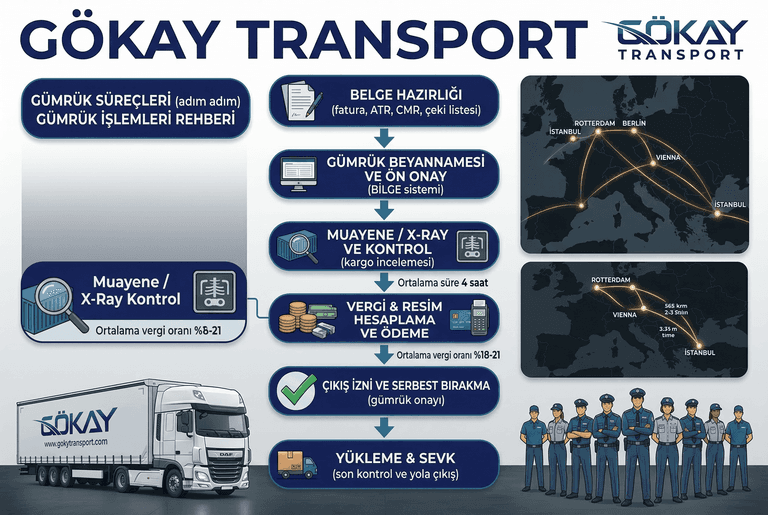
Customs Procedures Guide: Everything You Need to Know About Road Freight (2026)
How are customs procedures handled in road freight? 2026 customs broker fees, border crossings, and required documents — call us for a free consultation.
Food Export & Refrigerated Transport Guide: Prices, Documents and Cold Chain Logistics 2026
Refrigerated transport prices 2026: country-by-country cold chain shipping rates, ATP certificate, food export documents. Call now for a free quote.
Get in Touch
Available 24/7
You can reach us by email, by phone, or by filling out the form on this page. We aim to respond to your messages as quickly as possible and look forward to connecting with you!
Frequently Asked Questions (FAQ)Write to Us
We would love to hear from you!