
Customs Procedures Guide: Everything You Need to Know About Road Freight (2026)
When shipping goods by road from Turkey to Europe or neighbouring countries, customs procedures are the most critical stage. Shipments held up at the border crossing for days due to missing declarations, incorrect HS codes, or document errors cause serious financial losses. In this guide you will find everything specific to road freight customs — from how customs procedures work to customs broker fees, border crossing times, and required documents. Compiled from the field experience accumulated since 2010, when Gökay Transport began providing uninterrupted service to 14 countries, we recommend reading this comprehensive international road freight guide as a complementary reference.
What Are Customs Procedures?
What are customs procedures — the short answer: the process by which goods crossing from one country to another are subject to state control, assessed for duties, and cleared for release. What is customs clearance means the same thing; customs clearance in logistics covers all documents, declarations, and tax procedures that legally enable goods to cross a border.
Customs procedures in road freight have different dynamics compared to sea freight. CMR document, TIR carnet, border crossing times, and transit-country customs requirements are all elements specific to road transport. Gökay Transport has completed hundreds of crossings under different customs regimes (EU Customs Union, Balkan countries, Caucasus) thanks to its road freight experience across 14 countries.

2026 Customs Procedure Fees and Costs
How much do customs procedures cost is one of the most researched questions among exporters and importers. As of 2026, the official customs broker fee schedule is shown in the table below.
2026 Minimum Customs Broker Fee Schedule
Type of Service | Fee Range (TL) | Note |
|---|---|---|
Customs Brokerage (standard) | 7,000 – 15,940 TL | Varies by transaction type |
Authorised Customs Brokerage | 350 – 332,960 TL | High-security transactions |
Total fee cap | 78,000 TL | Exceeding this requires mutual agreement |
Discount for STCs/AEO holders | 20% discount | Including sectoral foreign trade companies |
Important Note: These figures represent the official minimum fee schedule that came into force on 1 January 2026. Actual fees may exceed these amounts. You need to obtain a quote with your cargo details for an exact cost.
Other Cost Components of Customs Procedures
The customs broker fee alone does not constitute the total cost. The customs declaration fee and additional line items must also be factored in:
- Stamp duty: Fixed amount per declaration
- Storage/demurrage fee: Charge for holding goods in the customs area
- Inspection costs: Where physical examination is required
- Bonded warehouse fee: When temporary storage is needed
- Transport documents: Fees for issuing CMR and TIR carnet
For a customs cost calculation specific to your cargo type, get a free quote via WhatsApp or call us directly on +90 533 302 33 10.

How Are Customs Procedures Handled in Road Freight?
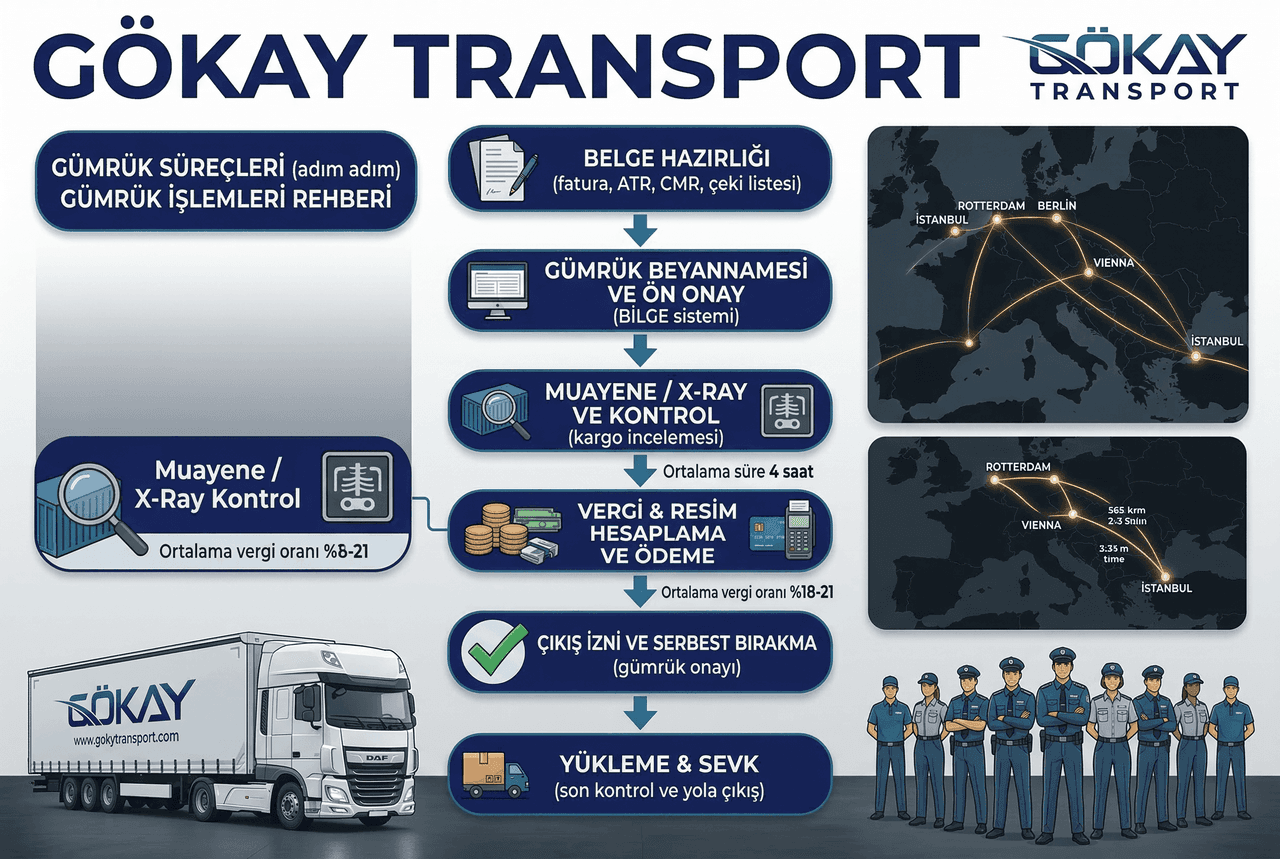
Road freight customs procedures require different documents and processes compared to sea or air freight. The customs clearance process consists of 6 key steps. Managing the customs procedures process correctly shortens transit time and prevents additional costs.
The 6 Steps of the Road Freight Customs Process
- Taxpayer registration and power of attorney: Taxpayer registration for customs purposes is completed and a notarised power of attorney is granted to the customs broker.
- Document preparation: Commercial invoice, packing list, CMR document, TIR carnet, and movement certificates (ATR/EUR.1) are prepared.
- Declaration entry into BİLGE: The customs broker prepares the customs declaration electronically through the BİLGE system.
- Cargo examination: The system routes the cargo to the blue, green, yellow, or red lane. Blue lane means clearance based on documents; red lane means physical inspection.
- Duty assessment and payment: Based on the HS code, customs duty calculation is performed and the assessed amount is paid.
- Release of goods: Once all checks and payments are completed, the goods are released from customs.
Customs process for full TIR loads differs from groupage shipments in terms of documents and declarations. A single declaration may suffice for a full load, whereas groupage shipments may require a separate declaration for each consignor.
Export Customs Procedures: Step-by-Step Process
Export customs procedures involve declaring goods departing from Turkey to the customs authority and obtaining exit approval. The question of how to handle export procedures is frequently asked, particularly by companies shipping abroad for the first time.
The export customs process consists of the following steps:
- Submission of the export declaration to the BİLGE system (with electronic signature)
- Registration of the declaration and approval by the customs authority
- Physical examination (if deemed necessary)
- Departure of goods from the export customs office
Incoterms delivery terms directly affect customs responsibility. EXW delivery means the buyer assumes all customs obligations, while DAP and DDP delivery means the seller's responsibility extends to the destination country. For example, customs procedures for textile exports are typically carried out under FOB or DAP terms.
You can review the full list of required export documents on our export documents list page.
Import Customs Procedures: Step-by-Step Process
Import customs procedures involve subjecting goods arriving in Turkey from abroad to customs control. For road freight, goods must be presented to customs within 20 days of entering through the border crossing.
Import process:
- Summary declaration: When goods reach the Turkish border, the driver or carrier submits a summary declaration.
- Bonded warehouse or temporary storage: Goods are held in the customs area.
- Opening the import declaration: The customs broker prepares the declaration through the BİLGE system.
- Examination: Blue, green, yellow, or red lane is applied.
- Tax payment: Customs duty + VAT + SCT (if applicable) + stamp duty are collected.
- Taking delivery of the goods: Once all taxes are paid, the goods are released.
Import tax components: Customs duty (depending on HS code: 0% – 150%+), VAT (20% standard rate), SCT (by product group), and stamp duty. The sum of these items directly affects import costs.
If you want to speed up your customs process and avoid unexpected costs, send us a message on WhatsApp.
What Is a Customs Declaration and How Is It Filled Out?
A customs declaration is the document by which goods are formally declared to the customs authority. In Turkey, all declarations are prepared electronically through the BİLGE (Computerised Customs Activities) system.
Key fields in the declaration:
- HS code: The customs tariff statistical position of the goods
- Cargo value: Invoice value (CIF or FOB)
- Country of origin: The country where the goods were produced
- Type and number of packages: Pallet, carton, trailer information, tonnage and volume details
- Weight: Gross and net kilograms
How is a customs declaration filled out — the short answer: the broker logs into BİLGE, completes the fields above, approves with an electronic signature, and registers the declaration. Multiple line items can be declared on a single declaration.
How Is a Customs Declaration Opened?
How is a customs declaration opened is a question frequently researched by companies engaging in foreign trade for the first time. Access to the BİLGE system requires customs broker authorisation and an electronic signature. A company cannot open a declaration on its own; the transaction must be carried out through a customs broker. The broker prepares the declaration using the power of attorney and documents received from the company.
For professional assistance with the customs declaration process, contact us on WhatsApp.
Documents Required for Customs Procedures
The document list specific to road freight differs from other modes of transport. Documents required for customs procedures are summarised in the table below.
Document Name | Purpose | When Required |
|---|---|---|
Commercial invoice | States the value of the goods and the terms of sale | Every shipment |
Packing list | Package, weight, and quantity details | Every shipment |
CMR document | Road freight contract of carriage | Every road freight shipment |
TIR carnet | Transit guarantee | When passing through transit countries |
ATR movement certificate | Tax exemption under the EU Customs Union | For exports of industrial goods to EU countries |
EUR.1 movement certificate | Preferential reduction under a free trade agreement | For exports to countries with an FTA |
Certificate of origin | Proves the country of production of the goods | When requested by the importing country |
Insurance policy | Coverage against risks during transport | Recommended for every shipment |
Health/veterinary certificate | Food and live animal inspections | Food, agricultural products |
Groupage transport shipments require each consignor to prepare their own set of documents. In consolidated loads, the number of declarations increases, which means additional broker fees.

Turkey's Border Crossings and Customs Transit Times
Knowledge of road freight customs border crossings is critical for shipment planning. Border crossing customs transit times vary by season, day, and traffic volume. Below are Turkey's main road freight border crossings and average transit times.
Border Crossing | Country | Average Transit Time | Peak Period | Practical Note |
|---|---|---|---|---|
Kapıkule | Bulgaria | 2–6 hours | Pre-holiday, summer | Turkey's busiest TIR border crossing |
Hamzabeyli | Bulgaria | 1–3 hours | When Kapıkule is congested | Alternative Bulgaria crossing |
İpsala | Greece | 1–4 hours | Summer, holidays | EU Customs Union advantage |
Sarp | Georgia | 2–5 hours | Weekends | Main gateway for the Caucasus route |
Gürbulak | Iran | 3–8 hours | Winter, Nowruz | Middle East transit hub |
Habur | Iraq | 4–12 hours | Permanently congested | Tanker and TIR queues are common |
Kapıkule Border Crossing (Bulgaria)
Kapıkule customs crossing is Turkey's busiest road transit point to Europe. Millions of TIRs pass through this gate every year. The average waiting time is 2–6 hours, which can exceed 12 hours in the pre-holiday period. Our Kapıkule Bulgaria border crossing route operates with weekly scheduled departures.
Other Important Border Crossings
- İpsala (Greece EU Customs Union advantage — fast clearance with ATR certificate)
- Sarp (Georgia Sarp customs crossing — gateway to the Caucasus and Central Asia)
- Hamzabeyli (alternative to Kapıkule, less congested)
- Gürbulak (Iran transit crossing)
- Habur (Iraq route, permanently high traffic)
To minimise your border crossing times and learn about our weekly scheduled departures, call us: +90 533 302 33 10.
What Is Customs Duty and How Is It Calculated?
What is customs duty — the answer: the tax levied by the state on imported goods. Customs duty calculation is based on the HS code and the country of origin of the goods. Current customs duty rates for 2026 are as follows:
- Customs duty: Based on HS code: 0% – 150%+
- VAT: 20% (standard), 10% (reduced), 1% (basic foodstuffs)
- SCT: Varies by product group (vehicles, alcohol, tobacco, etc.)
- Stamp duty: Fixed amount per declaration
Calculation formula: Customs Duty = CIF Value × Tax Rate (%). CIF value = cargo value + freight + insurance.
Situations Where Customs Duty Exemption Applies
Customs duty exemption applies in many situations:
- EU countries with ATR certificate: Zero customs duty on industrial goods
- Temporary import/export: Goods for fairs, exhibitions, and testing
- Free zone: Duty-free production and storage
- Bonded warehouse regime: No duty accrues while goods remain in the warehouse
- Inward processing regime: Importing raw materials and exporting the processed product
Companies carrying out road freight to EU countries in particular gain a significant cost advantage with the ATR certificate. This is one of the greatest benefits provided by the Turkey–EU Customs Union agreement.
What Is a Customs Broker and What Do They Do?
A customs broker is an authorised professional who represents companies before the customs authority in import and export transactions. Preparing declarations, checking documents, calculating duties, and tracking cargo are their main responsibilities.
A direct representative acts in the name and on behalf of the company, while an indirect representative acts in their own name but on the company's account. The power of attorney for customs procedures must be notarised.
Broker selection criteria:
- Area of expertise: Experience in the relevant sector — road freight, food, textiles, etc.
- Location: Proximity to the border crossing used
- References: Existing client portfolio
- Digital capability: BİLGE system and e-declaration infrastructure
The application for taxpayer registration for customs purposes is submitted to the Ministry of Trade together with the tax plate, signature circular, and trade registry gazette. The application can also be initiated through the e-Government portal. Taxpayer registration is mandatory before a customs declaration can be prepared.
Transit Customs Procedures (Bulgaria, Romania, Serbia)
When shipping goods from Turkey to Germany or Italy, transit countries such as Bulgaria, Romania, Serbia, Hungary, and Austria are crossed along the way. Customs procedures apply at each transit crossing.
Route | Transit Customs | Document | Average Time |
|---|---|---|---|
Kapıkule – Sofia | Bulgaria customs | TIR carnet / T1 | 1–2 hours |
Sofia – Bucharest | NCTS T1 document | 1–2 hours | |
Bucharest – Budapest | Hungary EU internal crossing | T1 or free circulation | 30 min – 1 hour |
Budapest – Vienna | Austria EU internal crossing | Free circulation | 15–30 min |
Vienna – Munich/Berlin | Destination customs | 1–3 hours |
TIR carnet serves as a guarantee in transit crossings. T1 document is the NCTS (New Computerised Transit System) document used for goods in transit within the EU. Gökay Transport's weekly scheduled departures make crossing times predictable on these routes and ensure that delivery commitments are met.
Customs Differences Between EU and Non-EU Countries
Gökay Transport serves 14 countries subject to different customs regimes. Knowing the key differences between EU member states and non-EU countries is decisive for cost and timeline planning.
Criterion | EU Countries | Non-EU Countries |
|---|---|---|
Customs Union | Applicable (tax exemption with ATR) | Not applicable |
Customs duty | 0% on industrial goods | 0%–150%+ depending on HS code |
Movement certificate | ATR or EUR.1 | Certificate of origin |
Transit facilitation | NCTS with T1 document | TIR carnet mandatory |
Additional document requirements | Standard | Quotas, licences, additional certificates |
Example countries | Germany, Italy customs procedures, Greece, Bulgaria | Georgia, Russia, Armenia |
Under the Turkey–EU Customs Union, goods exported from Turkey to Germany, Italy, or Bulgaria — specifically industrial goods — pass customs duty-free with an ATR certificate. However, agricultural products are outside this scope and are subject to separate preferential trade agreements.
For detailed information on customs processes for shipments to 14 countries, send us a message on WhatsApp.

Insurance in Customs Procedures: CMR Insurance
None of our competitors explain the relationship between insurance and the customs process in detail. Yet when goods are damaged or lost at customs, insurance coverage is of vital importance.
CMR insurance is the international convention governing the carrier's liability in road transport. Standard CMR coverage is limited to 8.33 SDR/kg (approximately 10–12 EUR/kg). For high-value cargo, All Risks cover should be preferred.
When damage is detected in the customs area, an endorsement is added to the CMR document. This endorsement is the starting point of the claims process. Gökay Transport provides CMR insurance on all shipments at no additional charge. For more comprehensive information, please review our freight insurance guide page.
How Long Do Customs Procedures Take?
How long do customs procedures take is one of the most critical elements of shipment planning. For road freight, goods must be presented to customs within 20 days of entering through the border crossing.
Type of Transaction | Average Duration | Notes |
|---|---|---|
Standard processing (green/blue lane) | 1–3 business days | Complete documents, low-risk cargo |
Yellow lane (document check) | 2–5 business days | Cargo requiring document review |
Red lane (physical inspection) | 5–10 business days | Physical check, sample taking |
Document deficiency | 10–20 business days | On hold until deficiency is resolved |
How many days do customs procedures take — the general answer: for standard cargo with complete documents, 1–3 business days; for cargo requiring physical inspection, 5–10 business days. Factors affecting duration: Missing documents, incorrect HS code, border crossing congestion, cargo type (food/chemicals face stricter checks), and country-specific additional requirements.
For customs procedure tracking, the declaration status can be queried through the BİLGE system. In addition, Gökay Transport uses its GPS live tracking system to notify you in real time — whether your cargo is at customs, en route, or at the border crossing — 24/7. How to track customs procedures — this is the most reliable answer.
Customs Procedures with Gökay Transport
Freight companies with customs support — when choosing, look not only at transport but also at the capacity to manage the customs process end to end. Gökay Transport has been specialised in road freight since 2010 and is one of the leading companies in the sector. Door-to-door customs-assisted transport services and an on-time delivery guarantee are the hallmarks of the professional solutions offered.
- L2 Licence (U.NET Registered): Legal authority for international road transport. Working with unlicensed carriers creates problems at customs.
- CMR Insurance: CMR insurance coverage is provided on all shipments at no additional charge.
- GPS Live Tracking: Track the real-time location of your cargo throughout the entire route, including the customs stage.
- 14-Country Experience: Thousands of crossings under different customs regimes across the EU, Balkans, and Caucasus.
- Weekly Scheduled Departures: Predictable planning with confirmed Wednesday and Friday European departures.
- Professional Customs Support: Our experienced team is by your side at every stage, from document preparation to declaration tracking.
To speed up your customs procedures and ship with confidence, get a free quote. Or call us directly: +90 533 302 33 10.

Frequently Asked Questions (FAQ)
How long do customs procedures take?
The statutory period for presenting goods to customs by road is 20 days. Under normal processing, the customs procedure is completed within 1–3 business days. Cargo routed to the red lane for physical inspection may take 5–10 business days. Missing documents are the most common cause of delays. Gökay Transport keeps the process transparent by providing real-time location updates through its GPS live tracking system.
How much do customs procedures cost?
As of 2026, customs broker fees range from 50 TL to 15,940 TL. On top of that, stamp duty, storage fees, and customs duties apply. The total cost varies depending on the cargo value, the type of transaction, and the goods' HS code. Fees for authorised customs brokerage services range from 350 TL to 332,960 TL.
How is a customs declaration filled out?
The customs declaration is completed electronically through the BİLGE system. The HS code, cargo value, country of origin, and packaging information are entered. The declaration is generally prepared by a customs broker and approved with an electronic signature. Multiple line items can be declared on a single declaration. Gökay Transport works with experienced customs brokers to accelerate your declaration process.
What does a customs broker do?
A customs broker handles customs authority procedures on behalf of companies in import and export transactions. Preparing declarations, checking documents, calculating duties, and tracking cargo are the main duties. They may act as a direct or indirect representative. A notarised power of attorney is required to engage a customs broker. Gökay Transport works with trusted brokers on every route to ensure your customs process runs smoothly.
How much does a customs broker charge?
According to the 2026 official minimum fee schedule, the customs brokerage service fee ranges from 50 TL to 15,940 TL. For authorised customs brokerage, fees of 350 TL to 332,960 TL apply. Sectoral foreign trade companies and DTSŞ and AEO holders receive a 20% discount.
What documents are required for customs procedures?
For road freight, the documents required for customs procedures are: commercial invoice, packing list, CMR document, TIR carnet, ATR or EUR.1 movement certificate, certificate of origin, and insurance policy. Depending on the type of goods, additional documents such as a health certificate or phytosanitary certificate may also be required. For the full list, review our export documents guide or ask us via WhatsApp.
How is a power of attorney obtained for customs procedures?
Power of attorney for customs procedures is obtained by applying to a notary. It is drawn up under the heading “Special power of attorney for customs procedures.” The duration, scope, and limits of the authority must be stated in the document. A broker appointed as a direct representative can carry out all customs transactions on behalf of the company. If you have any doubts about the power of attorney, contact us on WhatsApp.
How is taxpayer registration completed for customs purposes?
The application for taxpayer registration for customs purposes is submitted to the Ministry of Trade. A tax plate, signature circular, and trade registry gazette are required. The application can also be initiated through the e-Government portal. Taxpayer registration is mandatory before a customs declaration can be opened. Gökay Transport guides client companies through the taxpayer registration process.
What does ‘customs procedures completed’ mean?
‘Customs procedures completed’ means that the declaration has been approved, taxes have been collected, and the goods have passed through customs control. After this stage, the goods can be collected or continue their transit journey. In road freight, once goods are released, they set off towards their destination. Gökay Transport, GPS live tracking notifies you of the moment of customs clearance in real time.
Is there a customs advantage for exports to EU countries?
Yes. Under the Turkey–EU Customs Union, an ATR movement certificate provides customs duty exemption on industrial goods. This offers a major cost advantage for exports to EU countries such as Germany, Italy, Greece, and Bulgaria. Agricultural products, however, are outside the Customs Union’s scope and are subject to separate preferential trade agreements.
How are customs duties paid?
Customs duties are paid by bank transfer, credit card, or cash at the customs office. BİLGE system notifies banks of the assessed amount. 30 days — if not paid within this period, late payment interest is applied. For high-value duties, deferred payment with a letter of guarantee is also possible. For detailed information on duty calculation, contact us.
Are customs procedures in road freight different from sea freight?
Yes. In road freight, a CMR document and a TIR carnet are used, whereas in sea freight a bill of lading is used. The deadline for presenting goods to customs by road is 20 days; by sea it is 45 days. Additionally, in road freight, the border crossing transit time is added to the total transit time. Gökay Transport, with its expertise in road freight to 14 countries, provides consultancy in both modes.
Frequently Asked Questions
For road freight, goods must be presented to customs within 20 days of crossing the border. Under normal circumstances, the customs process is completed within 1–3 business days. Shipments routed to the red lane for physical inspection may take 5–10 business days. Missing documents are the most common cause of delays. Gökay Transport keeps the process transparent by providing real-time location updates through its GPS live-tracking system.
As of 2026, customs broker fees range from 50 TL to 15,940 TL. On top of that, stamp duty, storage fees, and customs duties apply. The total cost varies depending on the cargo value, the type of transaction, and the HS code of the goods. Fees for authorised customs brokerage services range from 350 TL to 332,960 TL.
Customs declarations are completed electronically through the BİLGE system. The HS code, cargo value, country of origin, and packaging details are entered. The declaration is generally prepared by a customs broker and approved with an electronic signature. Multiple line items can be declared on a single declaration. Gökay Transport works with experienced customs brokers to accelerate your declaration process.
Documents required for customs procedures in road freight include: commercial invoice, packing list, CMR document, TIR carnet, ATR or EUR.1 movement certificate, certificate of origin, and insurance policy. Depending on the type of goods, additional documents such as a health certificate or phytosanitary certificate may also be required. For the full list, you can review our export documents guide.
Related Articles
Bulgaria Freight 2026 | Daily Scheduled Departures & Freight Rates
Full-load, part-load, and refrigerated transport solutions from Istanbul to Sofia starting from €200. Browse our current rate sheet for safe, fast delivery.
Food Export & Refrigerated Transport Guide: Prices, Documents and Cold Chain Logistics 2026
Refrigerated transport prices 2026: country-by-country cold chain shipping rates, ATP certificate, food export documents. Call now for a free quote.
Shipping from Turkey to Germany: 2026 Prices, Routes and Service Guide
Turkey to Germany freight rates for 2026. Full truckload, LTL and refrigerated options. Weekly departures, CMR insured. Request a free quote.
Get in Touch
Available 24/7
You can reach us by email, by phone, or by filling out the form on this page. We aim to respond to your messages as quickly as possible and look forward to connecting with you!
Frequently Asked Questions (FAQ)Write to Us
We would love to hear from you!