
Food Export & Refrigerated Transport Guide: Prices, Documents and Cold Chain Logistics 2026
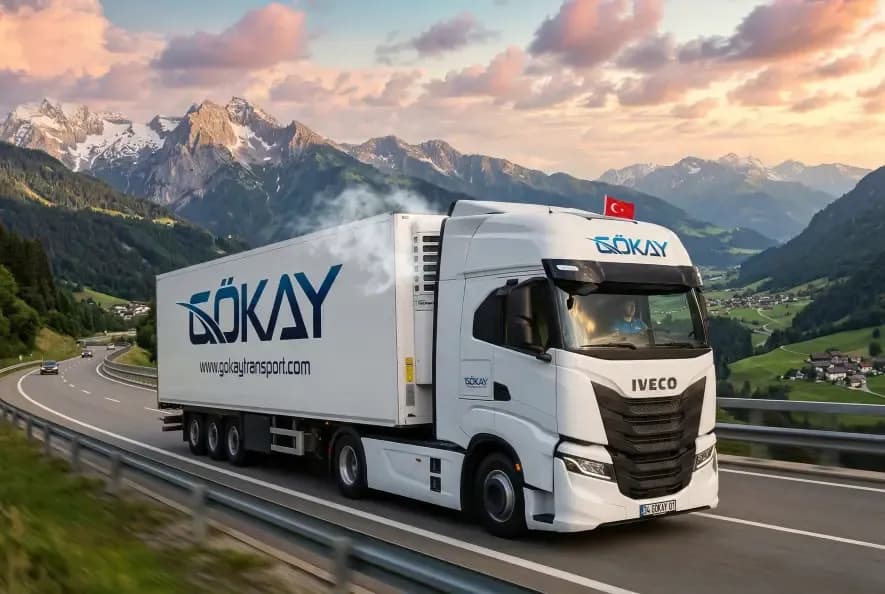
Turkey, in 2025, 36.4 billion dollars in food and agricultural exports makes it one of the world's largest food suppliers. A significant portion of this volume consists of temperature-sensitive products that must be transported by refrigerated freight. Fresh fruit and vegetables, meat products, dairy products and frozen foods must reach their target markets without any break in the cold chain.
Gökay Transport, since 2010, within the scope of our international freight services has been operating regular refrigerated transport runs to 14 countries. In this guide you will find 2026 current refrigerated transport prices, food export documents, ATP certificate, product-specific transport temperatures and route details.
Refrigerated Transport Prices 2026: How Much?
Full-Load Refrigerated TIR Prices
Route | Full-Load Refrigerated TIR | Transit Time | Temperature Range |
|---|---|---|---|
Istanbul – Germany | 5,500 – 7,000 EUR | 4–6 days | -25°C / +25°C |
Istanbul – Italy | 5,000 – 5,800 EUR | 3–5 days | -25°C / +25°C |
Istanbul – Russia (Moscow) | 8,500 – 10,500 USD | 5–7 days | -25°C / +18°C |
Mersin – Germany | 6,200 – 7,800 EUR | 5–7 days | -25°C / +25°C |
Antalya – Europe (general) | 5,500 – 7,000 EUR | 4–7 days | -18°C / +18°C |
Izmir – Germany | 5,800 – 7,400 EUR | 4–6 days | -25°C / +25°C |
Refrigerated transport prices are, on average, 15–25% higher than standard road freight. The fuel consumption of the cooling unit, the cost of ATP-certified vehicles and temperature monitoring systems are the main reasons for this difference.
Part-Load Refrigerated Transport Prices
Unit | Europe Lane | Russia / Caucasus Lane |
|---|---|---|
1 m3 | 250 – 400 EUR | 250 – 420 USD |
1 pallet | 350 – 500 EUR | 420 – 580 USD |
1 LDM | 500 – 620 EUR | 520– 700 USD |
Important Note: Prices vary depending on fuel costs, seasonal demand, temperature regime and cargo type. Refrigerated transport prices in 2026 may be affected by fluctuations in exchange rates and diesel prices throughout the year. We recommend requesting a firm quote tailored to your specific cargo.
With refrigerated part-load transport, you can gain a cost advantage on small-volume food shipments. A minimum of 1 pallet or 1 m3 of cargo is accepted. To receive a refrigerated transport price quote specific to your route, contact us via WhatsApp or call +90 533 302 33 10 directly.
What Is Refrigerated Transport?
Refrigerated transport is a logistics service that moves temperature-sensitive products in specially cooled (frigorific) vehicles, maintaining a controlled temperature range between -25°C and +25°C. Perishable products such as food, pharmaceuticals, flowers and chemicals are transported in ATP-certified refrigerated vehicles, and the temperature is continuously monitored throughout the shipment. Cold chain logistics aims to ensure that the temperature chain is never broken at any stage from production to consumption.
The shortest answer to the question of what food logistics is: it is the process of transporting perishable food products from the point of production to the point of consumption while preserving their quality and safety. In this process, refrigerated transport standards, ATP certification and cold chain protocols come into play.
Main sectors requiring refrigerated transport:
- Food export: Fresh fruit and vegetables, meat, dairy products, frozen food, seafood
- Pharmaceutical logistics: Vaccines, biological medicines, blood products (+2°C / +8°C)
- Flower transport: Cut flowers, seedlings (+1°C / +5°C)
- Chemicals: Heat-sensitive chemicals, cosmetic raw materials
Product-Specific Transport Temperatures: At What Temperature Are Goods Carried?
Product Category | Transport Temperature | Notes |
|---|---|---|
Frozen meat and fish | -18°C or below | Re-freezing once thawing has begun is prohibited |
Frozen vegetables / fruit | -18°C or below | Maximum temperature deviation +3°C |
Fresh meat (red meat) | 0°C / +2°C | Ventilation required |
Poultry (chicken) | 0°C / +4°C | Salmonella risk: hygiene is critical |
Dairy products (cheese, yoghurt) | +2°C / +6°C | Humidity control is important |
Fresh fruit and vegetables | +2°C / +8°C | Ethylene compatibility must be checked |
Citrus (oranges, lemons) | +3°C / +7°C | Watch out for chilling injury |
Flowers (cut flowers) | +1°C / +5°C | Upright transport is mandatory |
Pharmaceuticals / vaccines | +2°C / +8°C | GDP compliance required |
Chocolate and confectionery | +15°C / +18°C | Humidity must remain below 50% |
Dry food | +15°C / +25°C | Temperature control is sufficient |
Beverages (fruit juice) | +10°C / +15°C | Must be protected from direct sunlight |
In cold chain transport, each product category has its own specific temperature requirements. The table above shows the mandatory transport temperatures in accordance with international ATP standards.
Meat product transport temperature is one of the most sensitive categories. Fresh meat must be transported between 0°C and +2°C, while frozen meat must be transported at -18°C or below. Fruit and vegetable refrigerated transport temperatures vary over a wide range, from 0°C to +13°C, depending on the type of product.

What Documents Are Required for Food Export?
The documents required for food export are as follows:
- HACCP or ISO 22000 food safety certificate
- Health Certificate — obtained from the Ministry of Agriculture and Forestry
- Phytosanitary Certificate — required for plant-based products
- Veterinary health certificate — required for animal products (meat, dairy, honey)
- EUR.1 or ATR movement certificate — for EU customs exemption
- Commercial invoice and packing list
- CMR document — road transport contract
- Customs declaration — with Ministry of Agriculture approval code
- ATP certificate — vehicle conformity document for the transport of perishable foodstuffs
food export regulations covers both food safety certificates and trade/customs documents. The answer to how to export food abroad lies in having the correct documentation in place.
Food Safety Certificates (Detail)
- HACCP Certificate — Hazard Analysis and Critical Control Points system. Mandatory for food exports to EU countries. Issued by an accredited body; validity period: 3 years.
- ISO 22000 Food Safety Management System — Internationally recognised food safety standard. It is the higher-level version of HACCP.
- Food export health certificate (Health Certificate) — Obtained from the Ministry of Agriculture and Forestry. Issued separately for each shipment.
- Phytosanitary Certificate — Mandatory for the export of fresh fruit and vegetables, grains, and legumes. Issued by the Provincial Directorate of Agriculture.
- Veterinary Health Certificate — Mandatory for the export of animal products (meat, dairy, honey). Requires approval from the Animal Health Directorate.
Customs and Trade Documents
- Commercial Invoice — Goods value, buyer and seller details
- Packing List — Box/pallet details, weights and dimensions
- EUR.1 / ATR Movement Certificate — For customs exemption on exports to EU countries
- Certificate of Origin — Certifies that the product is of Turkish origin
- Customs declaration — Export declaration, with Ministry of Agriculture approval code
- CMR Document — Road transport contract; defines carrier liability
- Perishable foodstuffs transport document (ATP Certificate) — Certifies that the vehicle is suitable for refrigerated transport
For detailed information, you can review the full customs process in our food customs procedures guide. For the complete list of export documents, visit our food export documents page.
Membership of a food exporters' association makes the export process easier and allows you to benefit from available support programmes. To get assistance with the food export document process and to plan your refrigerated transport together, write to us.
What Is an ATP Certificate?
The ATP certificate is a mandatory conformity document issued by the United Nations Economic Commission for Europe that sets the standards for vehicles and equipment used in the international transport of perishable foodstuffs. Under the ATP (Agreement on the Transport of Perishable Foodstuffs), the FRC certificate is issued for mechanically refrigerated vehicles, is valid for 6 years, and can be renewed for a further 3 years. In Turkey, TSE (Turkish Standards Institution) is the authorised certification body.
ATP certificate types:
- FRC: Mechanically refrigerated, heavily insulated vehicles (most common)
- FNA: Normally insulated mechanically refrigerated vehicles
- FRA: Heavily insulated, Class A refrigerated vehicles
- RRC: Heavily insulated, mechanically refrigerated rigid trucks
Refrigerated transport to European Union countries cannot be carried out without an ATP certificate. When transport is carried out in a vehicle without a certificate, penalties are applied and the cargo may also be rejected at customs. All refrigerated vehicles in the Gökay Transport fleet hold a current FRC certificate.

Refrigerated Vehicle Types and Technical Specifications
The answer to what a refrigerated vehicle is: it is a road transport vehicle whose interior is lined with special insulating material and fitted with a mechanical cooling unit. The technical specifications of the vehicles used for refrigerated transport directly affect cargo safety.
Refrigerated trailer types:
- Single-temperature refrigerated trailer: Single-compartment, adjustable between -25°C and +25°C. Standard capacity: 33 Euro pallets. Ideal for single-type cargo.
- Dual-temperature (multi-temp) trailer: Two different temperature regimes separated by an interior partition wall. For example, the front compartment at -18°C (frozen) and the rear compartment at +4°C (fresh). Used for mixed cargo.
- Refrigerated minivan: 3–5 pallet capacity small refrigerated vehicle. Preferred for urban distribution and small part-load shipments.
Cooling systems: Mechanical cooling (compressor + evaporator + condenser) is the most common system. Operates via the vehicle engine or an independent diesel unit. A thermostat controls the temperature, while a data logger records temperature data throughout the shipment.
Refrigerated Routes from Turkey to Europe and the Caucasus
Gökay Transport operates regular international refrigerated freight services to 14 countries. Below, the main refrigerated routes, transit times and border crossings are detailed.
European Refrigerated Routes
The main route for refrigerated transport from Turkey to Europe: Istanbul / Mersin / Antalya – Kapıkule – Bulgaria route into the EU – Serbia – Hungary – destination country. The alternative route via Romania is also actively used.
Route | Transit Time | Border Crossing | Departure Frequency |
|---|---|---|---|
Istanbul – Germany (Munich) | 4–6 days | Kapıkule | Weekly (Tuesday, Friday) |
Istanbul – Italy (Milan) | 3–5 days | Kapıkule / Ro-Ro | Weekly (Wednesday) |
Mersin – Germany | 5–7 days | Kapıkule | Weekly (Thursday) |
Antalya – Europe (general) | 4–7 days | Kapıkule | Weekly (Tuesday) |
Our Germany food export transport lane is our busiest refrigerated route. On the Italy refrigerated transport lane, access to the ports of Trieste and Bari is provided via our Italy refrigerated transport lane using the Ro-Ro option.
Russia and Caucasus Refrigerated Routes
The main route on the Caucasus and Russia lane: Trabzon / Artvin – Sarp border crossing – Georgia Caucasus route – Russia. Via our Russia refrigerated transport lane, deliveries to Moscow are made in 5–7 days.
City-Based Departure Points
Direct refrigerated loading is carried out from Turkey's various production regions:
- Istanbul: General food exports, frozen products, dairy products. Among Istanbul refrigerated transport companies, Gökay Transport coordinates from its Ataşehir headquarters. Our Istanbul refrigerated transport hub provides weekly regular departures.
- Mersin: The heart of citrus exports. Mersin refrigerated transport — orange, lemon, mandarin season: October–February.
- Antalya: Greenhouse produce (tomatoes, peppers, cucumbers). A trusted partner among Antalya refrigerated transport companies.
- Izmir: Olives, olive oil, figs, dried grapes. Izmir refrigerated transport for Aegean region exports.
- Gaziantep: Pistachios, pulses, dried nuts. Gaziantep refrigerated transport for shipments departing from south-eastern Turkey.
- Konya: Grain, sugar beet, dry foods. Our Konya refrigerated transport service covers the Central Anatolia region.
- Ankara: General food, meat products. Ankara refrigerated transport for shipments departing from the capital.

To plan refrigerated transport from your city to Europe or the Caucasus, contact us via WhatsApp now.
Full-Load Refrigerated TIR or Part-Load Refrigerated?
Criterion | Full-Load Refrigerated TIR | Part-Load Refrigerated |
|---|---|---|
Cargo volume | 20+ pallets / 45+ m3 | 1–10 pallets / 1–15 m3 |
Cost | 3,500 – 7,500 EUR (depending on route) | 180 – 520 EUR/unit |
Temperature control | Full control dedicated to a single cargo | Temperature compatibility of mixed cargo required |
Transit time | Direct delivery, faster | Consolidation adds 1–2 days |
Suitable cargo type | Large-batch export | Samples, small orders, trial shipments |
Choosing the right transport model based on your refrigerated cargo volume directly affects cost. You can find a detailed comparison in our full-load refrigerated TIR vs. part-load refrigerated guide.
In our part-load cold chain transport service, products sharing the same temperature regime are carried together. With full-load refrigerated TIR, the entire trailer capacity is allocated to a single customer and the temperature setting is adjusted specifically for that cargo.
Seasonal Product Calendar and Transport Planning
Period | Product | Main Departure City | Target Market |
|---|---|---|---|
January – March | Citrus (oranges, lemons) | Mersin, Antalya | EU, Russia |
March – June | Strawberries, cherries (early) | Istanbul, Bursa | EU |
April – July | Cherries, apricots | Isparta, Malatya | Germany, England |
June – September | Peaches, nectarines, grapes | Izmir, Denizli | EU, Russia |
September – November | Pomegranates, apples, pears | Antalya, Mersin | EU, Middle East |
October – February | Citrus (mandarins, grapefruit) | Mersin, Adana | EU, Russia |
Year-round | Tomatoes, peppers (greenhouse) | Antalya | EU, Russia |
Year-round | Frozen food, meat products | Istanbul, Gaziantep | EU, Caucasus |
Food exports are largely seasonal. Booking capacity at the right time is decisive both in terms of cost and product quality. Refrigerated vehicle capacity fills up quickly before peak season. Early booking is critically important, especially during the cherry season (April–July) and the citrus season (October–February).
Cold Chain Technology and Live GPS Tracking
cold chain logistics technology is the fundamental guarantee of product safety. All refrigerated vehicles in the Gökay Transport fleet are equipped with the following systems:
- Live GPS tracking system: You can monitor the vehicle's real-time location 24/7. Shipment status, estimated arrival time and route information are updated in real time.
- Temperature monitoring sensors (IoT): The interior temperature of the trailer is transmitted instantly to the central system. An automatic alarm is triggered if the temperature goes outside the specified range.
- Data logger (temperature recording device): Records temperature data throughout the shipment. Printed at the point of delivery and handed over to the consignee. Used as evidence in the event of a damage claim.
- Digital shipment tracking portal: Our customers can monitor shipment status, temperature graphs and document flow from their own dashboard.
When choosing cold chain logistics companies, GPS tracking and temperature monitoring capability are among the most important criteria. Gökay Transport's specialist team responds immediately to temperature alarms.
How Does CMR Insurance Work in the Event of Cold Chain Damage?
For products damaged due to a temperature deviation, the carrier pays compensation under CMR insurance. The maximum compensation limit is 8.33 SDR per gross kilogram (approximately 10–11 EUR). For higher coverage, an All Risks additional cover policy is recommended. In the event of damage, data logger (temperature recording device) data is of critical importance as evidence. For more information, you can take a look at our cold chain insurance guide.
CMR insurance coverage (in refrigerated shipments):
- Product spoilage caused by temperature deviation is covered
- Maximum compensation limit: 8.33 SDR per gross kilogram (approximately 10–11 EUR)
- The carrier's fault must be proven (data logger records are critical)
- All Risks additional cover policy provides protection above the SDR limit
What to do in the event of damage:
- Check the temperature record (data logger) at the point of delivery
- Note any damage / reservation on the CMR document
- Carry out a photographic damage assessment
- Send written notification to the carrier within 48 hours
All Gökay Transport refrigerated shipments are covered by CMR insurance. In the event of losses caused by temperature deviation or mechanical failure, the claims process is managed with full support for you.
For CMR-insured refrigerated transport service and detailed coverage information, contact Gökay Transport or call +90 533 302 33 10.
Why Choose Gökay Transport for Refrigerated Transport?
refrigerated transport companies, 6 concrete reasons to choose Gökay Transport:
- L2 Authorisation Certificate (U.NET Registered): We hold the L2 authorisation certificate, the legal requirement for international refrigerated transport. Registered in the U.NET system, all our European services are officially recorded. When selecting international refrigerated transport companies, always check for this certificate.
- CMR Insurance (on All Shipments): All our shipments, including cold chain cargo, are transported with CMR insurance. In the event of spoilage or damage, we are by your side throughout the claims process.
- Live GPS Tracking and Temperature Monitoring: Track the location of your cargo and the cooling temperature live, 24/7. An instant-response system for temperature deviations is in place.
- Experience Since 2010: Over 16 years of cold chain transport expertise makes us a trusted partner among food logistics companies. Among refrigerated carriers, we have the most experienced team in the industry.
- 14-Country Service Network: We have a regular refrigerated service network across 14 countries from Europe to the Caucasus. We are one of the few companies among food transport companies offering a service network of this breadth.
- Weekly Regular Departures: We commit to the on-time delivery of your cargo by operating a guaranteed weekly departure refrigerated service on all main routes. Among cold chain logistics companies, we have the most comprehensive departure schedule.

Frequently Asked Questions (FAQ)
How much do refrigerated transport prices cost in 2026?
Rates vary by route. A full-load refrigerated TIR from Istanbul to Germany is priced at 4,800–6,200 EUR, and from Istanbul to Italy at 3,500–4,800 EUR. For part-load refrigerated transport, the rate is approximately 180–280 EUR per m3. Refrigerated transport runs 15–25% higher than standard TIR. Contact Gökay Transport for an up-to-date price quote.
What is refrigerated transport?
Refrigerated transport is a logistics service that moves temperature-sensitive products (food, pharmaceuticals, flowers, chemicals) in vehicles equipped with specialised cooling systems, maintaining a controlled temperature range between -25°C and +25°C. ATP-certified refrigerated vehicles are used, and the temperature is continuously monitored throughout the shipment. Keeping the cold chain unbroken is critical for product quality and food safety.
What documents are required for food export?
Documents required for food export: HACCP or ISO 22000, food export health certificate (Health Certificate), phytosanitary certificate, veterinary health certificate, EUR.1/ATR, commercial invoice, packing list, CMR document, and customs declaration. Approval from the Ministry of Agriculture and Forestry is mandatory.
At what temperature must frozen food be transported?
Frozen food products must be transported at -18°C or below. Frozen meat and fish at -18°C, frozen vegetables and fruit at -18°C, and ice cream and frozen desserts between -20°C and -25°C. Temperature deviation must not exceed +3°C throughout the cold chain. For the question of how to export frozen food, see the documents section above.
What is an ATP certificate and how is it obtained?
ATP (Agreement on the Transport of Perishable Foodstuffs) is a mandatory conformity document that sets the standards for vehicles and equipment used in the international transport of perishable foodstuffs. The FRC certificate is issued for mechanically refrigerated vehicles, is valid for 6 years, and can be renewed for a further 3 years. In Turkey, TSE is the authorised certification body. In Europe, refrigerated transport cannot be carried out without an ATP certificate.
How does CMR insurance work for cold chain cargo damage?
For products damaged due to a temperature deviation, the carrier pays compensation under CMR insurance. The maximum compensation limit is 8.33 SDR per gross kilogram (approximately 10–11 EUR). For higher coverage, an All Risks additional cover policy is recommended. In the event of damage, data logger data is of critical importance as evidence.
How is food export carried out?
Food export is carried out in 7 steps:
- Obtain an exporter certificate
- Acquire an HACCP or ISO 22000 food safety certificate
- Research the food regulations of the target country
- Obtain approval from the Ministry of Agriculture and Forestry
- Prepare the health certificate and required documents
- Open the customs declaration
- Agree with an ATP-certified refrigerated transport company
The process varies depending on the product type and target country.
How do I choose companies that carry out refrigerated transport?
When choosing companies that carry out refrigerated transport, pay attention to 5 criteria:
- Must hold an L2 authorisation certificate and U.NET registration
- Fleet must be ATP/FRC certified
- CMR insurance must be in place for all shipments
- Must have a live GPS tracking and temperature monitoring system
- Regular departure schedule and references must be checked
Companies that meet all of these criteria will be a reliable choice.
Should I choose a full-load refrigerated TIR or part-load refrigerated?
For cargo of 20 pallets or more, or over 45 m3, a full-load refrigerated TIR is the economical choice. For cargo between 1–10 pallets or 1–15 m3, part-load refrigerated transport is more cost-effective. In part-load refrigerated transport, attention must be paid to the temperature compatibility of mixed cargo; only products sharing the same temperature regime are carried together.
What temperature should fruit and vegetable transport be?
The transport temperature for fruit and vegetables varies between 0°C and +14°C depending on the type of product. Cherries and strawberries between 0°C and +2°C, apricots and peaches between 0°C and +1°C, citrus between +3°C and +7°C, tomatoes between +10°C and +13°C, and bananas between +13°C and +14°C. Ethylene-producing and ethylene-sensitive products must be transported in separate compartments.
Is the HACCP certificate mandatory for food export?
For food exports to EU countries, HACCP or an equivalent food safety management system is mandatory. ISO 22000 has international validity and is accepted in many target countries. The certification process takes an average of 2–4 months. Food exported from non-certified production facilities may be rejected at customs.
How long does food export from Turkey to Europe take?
It depends on the route. Istanbul–Germany refrigerated transport takes 4–6 days, Istanbul–Italy 3–5 days, and Mersin–Europe 5–7 days. Customs procedures may add an extra 1–2 days. For cold chain products, waiting time at customs is critical; Gökay Transport minimises waiting time with customs broker support.
Get your refrigerated transport quote now. Request a free quote via WhatsApp. Gökay Transport — cold chain logistics since 2010, reliable refrigerated transport to 14 countries.
Frequently Asked Questions
Rates vary by route. A full-load refrigerated TIR from Istanbul to Germany is priced at 4,800–6,200 EUR, and from Istanbul to Italy at 3,500–4,800 EUR. For part-load refrigerated transport, the rate is approximately 180–280 EUR per m3. Refrigerated transport runs 15–25% higher than standard road freight. Contact Gökay Transport for an up-to-date quote.
Refrigerated transport is a logistics service that moves temperature-sensitive products (food, pharmaceuticals, flowers, chemicals) in vehicles equipped with specialised cooling systems, maintaining a controlled temperature range between -25°C and +25°C. ATP-certified refrigerated vehicles are used, and the temperature is continuously monitored throughout the shipment. Keeping the cold chain unbroken is critical for product quality and food safety.
Documents required for food export: HACCP or ISO 22000, food export health certificate (Health Certificate), phytosanitary certificate, veterinary health certificate, EUR.1/ATR, commercial invoice, packing list, CMR document, and customs declaration. Approval from the Ministry of Agriculture and Forestry is mandatory.
Food export is carried out in 7 steps: Obtain an exporter certificate Acquire an HACCP or ISO 22000 food safety certificate Research the food regulations of the target country Obtain approval from the Ministry of Agriculture and Forestry Prepare the health certificate and required documents Open the customs declaration Agree with an ATP-certified refrigerated transport company The process varies depending on the product type and target country.
Related Articles
Bulgaria Freight 2026 | Daily Scheduled Departures & Freight Rates
Full-load, part-load, and refrigerated transport solutions from Istanbul to Sofia starting from €200. Browse our current rate sheet for safe, fast delivery.
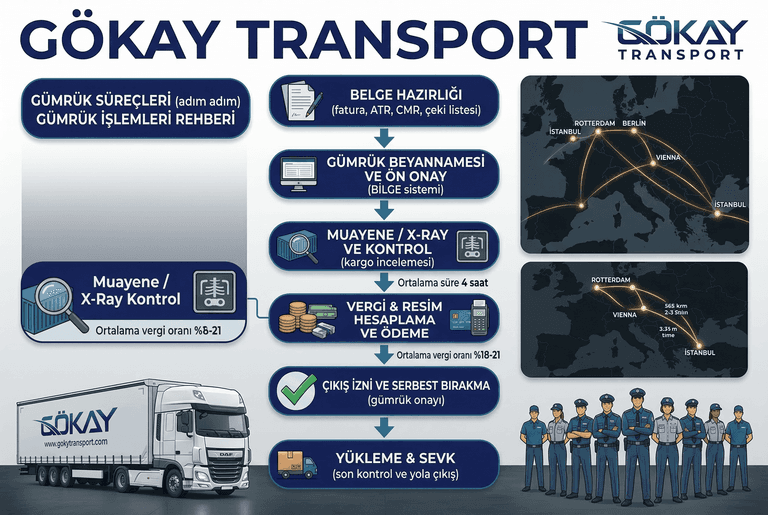
Customs Procedures Guide: Everything You Need to Know About Road Freight (2026)
How are customs procedures handled in road freight? 2026 customs broker fees, border crossings, and required documents — call us for a free consultation.
Shipping from Turkey to Germany: 2026 Prices, Routes and Service Guide
Turkey to Germany freight rates for 2026. Full truckload, LTL and refrigerated options. Weekly departures, CMR insured. Request a free quote.
Get in Touch
Available 24/7
You can reach us by email, by phone, or by filling out the form on this page. We aim to respond to your messages as quickly as possible and look forward to connecting with you!
Frequently Asked Questions (FAQ)Write to Us
We would love to hear from you!